Closing up the Manley house for the frigid Alaska winter is a job. Jerry had already drained the water softener, disconnected it and taken it to the dump, where presumably it will become an object for target practice. It never worked properly and having it gone saved time the last morning, since every drop of water has to be drained from the plumbing. All the pipes must be blown out with a compressor, the hot water heater drained, the toilet tank drained — one year Jerry forgot to drain that and we came back in spring to a block of ice in a toilet tank split in two pieces. Al, a former friend (before the great blog disaster) had an old tank that he gave us and fortunately it fitted.
While Jerry attended to the pipes I cleaned. I like the house to look perfectly ready for us when we come back. Then we took the small amount of left over food — stuff that can’t be frozen or that will be spoiled when the weather warms — over to the Redingtons. Pam said write an email when you get home to say you’ve arrived safely. Jerry said he likes getting emails from Pam to let him know what happens in Manley. Pam said the problem is nothing much happens. But I said there’s always weather, sometimes politics, and occasionally somebody dies or gets born or moves away. And there’s the possibility of progress on the Road to Tanana (some day to be the Road to Nome). A bear might become a nuisance and Joee might have to shoot it. Joee’s dogs might win a race. All that’s news.
So we hugged, said goodby and set out for Fairbanks. We needed to stop briefly to dispose of our accumulated rubbish; halfway to the dump Jerry remembered that he had forgotten to empty the 5 gallon blue plastic drinking water containers. If the containers froze in the winter they would crack and get water all over the floor so we had to go back to the house I had already said goodby to. I found going back unsettling. I was sad to leave, sadder than usual. At last this house seems like a permanent thing in my life: a significant home. We had thought of selling it, but nobody wanted to buy it, cute as it is, and I discovered that my attachment to it is deep enough to last as long as I can make the journey. It’s an easy house to live in, full of light, warm and pretty in a simple way. My mind’s at rest there like nowhere else. On Lummi I think about doctor’s appointments, the law suit, social obligations, children’s troubles, dog grooming, painting classes, and many other things, some pleasant, some not. In Manley I am at peace. We walk, not on the roads, but in the woods. I am a little bit scared of bears, but now that Jerry always carries bear spray (a kind of pepper spray that is said to work well) I don’t worry much. And we have never seen a bear in our woods, though Joee has. Once he told us a bear was hanging around our house and coming over to bother his dogs. He had to deal with it. On Lummi we walk a mile and a half loop on the road and if we see more than 3 cars Jerry mutters it’s like I 5. In Manley we walk in the lovely woods, mostly white birch sprinkled with white spruce. No cars.

The day we left, view out the living room window
Having said a second goodby to the house, we deposited our junk at the dump which caused legions of ravens feeding on its bounty to caw angrily and flap away into the trees. We drove on to Fairbanks. It was snowing, gently but persistently. The high places were slippery, but when we reached the junction with the paved Dalton Highway road conditions improved. We were welcomed at the Golden North Motel. Fox News was playing on TV in the reception area which made me want to get out of it fast and into our odd accommodation: behind the bedroom is a windowless room with a sofa and TV set. The windowless room is a good place for the poodles to sleep in their crate.
The next day we started late, took it easy and drove across the Canadian border to Beaver Creek where we stayed at Buckshot Betty’s. I decided that Betty’s ill humor, which I used to find entertaining, wasn’t funny anymore. Besides, the food is abysmal and the rooms are so small there’s no convenient place to put the poodle’s crate. On our next trip we will get up earlier in Fairbanks and go as far as Destruction Bay where there’s a well run truck stop and almost edible food.
The sun shone during most of the two days drive to Haines. Although I have driven this route many times, I am still astonished by the intense beauty of the huge, wild landscape. The mountains gleamed in the sun,

Sunrise in Yukon Territory
some jagged and snowy, some rubbed smooth by ancient ice, looking streaked in the fresh snow with black and white veins of spruce or birch.

New fallen snow in Yukon Territory
The lower hills, below the snow line were shades of green from lemon to olive, sometimes with patches of red and yellow to orange and magenta. I take hundreds of pictures of things I have taken hundreds of pictures of in the past. I take them from the moving truck, through the streaked windshield because Jerry doesn’t like to stop

On the way to Haines
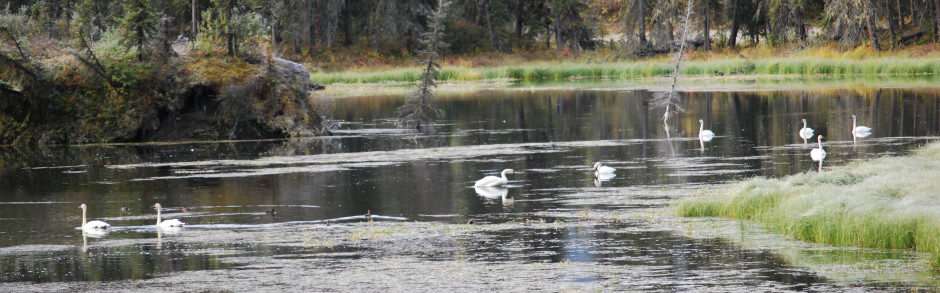
. He will stop for wildlife, but we didn’t see much wildlife on this trip. Lots of grouse a few eagles, a few swans, all too far off to photograph. I did take some photos of sheep far up the mountain at Kluane. Someday I’ll see them on the road where they come sometimes early or late in the day.

Mountain sheep
From Haines Junction in Yukon to Haines in Alaska we travel over a high mountain pass which can be snowy and sometimes barely passable. This time we were relieved to find it wet but clear. As we approached Haines it rained harder.

From Haines Junction to Haines
I love Haines. Its parks are fine, the surrounding mountains grand, the rivers and lakes full of birds and animals. The town itself is quirky and the vintage buildings of Fort Seward are sedate and well kept.

Looking toward Fort Seward
Sometimes at night bears roam the streets, and in daylight their images adorn the buildings. The police report in the local newspaper is mostly incidents of bears tipping over garbage cans. Jerry and I had 3 days there at the Captain’s Choice Motel which is comfortable and has a good view of the mountains and marina.
For 2 days the rain came down: sometimes hard, sometimes spitting softly. We saw a few wet eagles on the way from the Canadian border (later in the month there will be literally thousands of them.) We drove out to lovely (even in the rain) Chilkoot Lake where there was no place to park because every space was taken by campers from Yukon.

Parking at Chilkoot Lake
It was the weekend of Canadian Thanksgiving and landlocked Canadians flocked down to the sea to fish for salmon, rain or shine.

Fishing for salmon in Lake Chilkoot
They lined the shores of the rivers and lakes. At mealtimes they filled the Bamboo Room restaurant where we usually eat. However, because of the Canadians many of the shops stayed open, so when the rain was too heavy for walking in the parks and on the beach I could browse for earrings and books.
In Haines, since the weather was not so good for distance photography, I took pictures of forest things like mushrooms and berries.

I think this is Russula emetica. I could be corrected.

What are these berries? I see them all over Alaska
And I did catch an otter playing in the river.

Otter in the Chilkoot River
In Haines I had 2 things on my mind. The first was practical. We had arranged to park the truck on the property of a friend and take the ferry back to Bellingham as walk-ons. I wanted to connect with Christy Tengs Fowler, the owner of the Bamboo Room, because it is her mother’s yard where we will leave the truck. But I didn’t want to be a bother because I don’t know her very well. And I constantly worried, in my old lady way, about how we would carry the dogs on to the car deck and all our stuff onto the ferry and up to our cabin.
The second thing on my mind was frivolous. I had read Heather Lende’s book about Haines, If You Lived Here I’d Know Your Name, and during a rainy patch this time in Haines I bought her second book, Take Good Care of the Garden and the Dogs. I like her writing style, and I enjoy the simple stories of local folk and their life in Haines. She started her writing career as an obit writer in the local paper, and many of her stories are about death. As I read through her second book, which focuses a lot on death and things that happen near death, I begin to wonder whether it’s a really good thing for one such as I, 82 years old and approaching the end of my time here, to be getting preoccupied with the process of dying and the end result — death. Heather Lende solves the problem of not being by becoming more and more religious; religious in a pleasant, slightly mushy, way, but nevertheless, definitely believing. I don’t believe. I never have. I might like to, but I cannot. So for me this is no comfort.
Belief in a supernatural is, I think, something one is born with — or like me, without. I have a sister who is a true believer. We were raised mostly the same way by mostly the same people. Our grandfather, who we never knew, was an Anglican priest but our mother, though she liked going to church, was not a believer. My sister believes. She believes in everything: Jesus, Buddha, astrology, crystal healing, anything with a spiritual flavor. She says it was because a nice maid who took care of her for years taught her, but she was a more than willing pupil.
I digress. I had Heather Lende on my mind. I thought I would like to meet her. Tony Tengs (the world’s best bartender, who bartends on the ferry) is a mutual friend. He said I should just call her up. But she gets fan mail, for heavens sake, and I was again afraid I would be a bother. So I just kept looking at people on the street, wondering whether they might be her, or looking at houses in the area where she lives (she tells in her book) wondering whether it might be hers.
Our third day in Haines dawned bright with sunshine. We had to check out of the motel at 11 am , and the ferry doesn’t leave until 7 pm, so we were thankful for a sunny day. We went back to Chilkoot lake, now with only a few straggling Canadians because it was Monday morning and most of them had gone back to work. Then lunch was at a place where we could look over the small marina and out at the mountains that completely surround Haines. Then we shopped in a little store with a lot of “natural” products where I tasted fireweed honey, bought a book about mushrooms and some more earrings. But I was getting more worried about the logistics of our departure as time approached.
Jerry dropped me, the poodles and their airplane approved carrier, all our suitcases and bags of bottles of wine, dog food, art supplies, computer, DVD’s, books, and whatnot at the ferry dock. I said I’ll be so glad when you get back here. He drove the truck to town and parked it for the winter. While he was gone I saw some people I know, the parents of my Lummi friend Gwen, in the ferry line. I recognized them walking their 3 dachshunds. We agreed to meet on the boat. Christy (Tony Tengs’ sister and propriator of the Bamboo Room) drove Jerry back to the ferry, gave each of us a hug, and said goodby. We got our selves, our poodles and our stuff on the boat easily with a little help from the accommodating ferry workers. On the ferry (the Malaspina, my favorite boat) I stopped fretting about not meeting Heather Lende. As the boat departed I felt like a rational person in control of myself and my possessions. It was a good feeling.

 The workshops are fun, and include a vegetarian lunch with wine and brownies. When I came home I began preparations for my birthday.